Program and Presentations
2026 CONFERENCE PROGRAM
15 May 2026
2026 MASTERCLASS PROGRAM
Thursday 14 May 2026
Saturday 16 May 2026
-
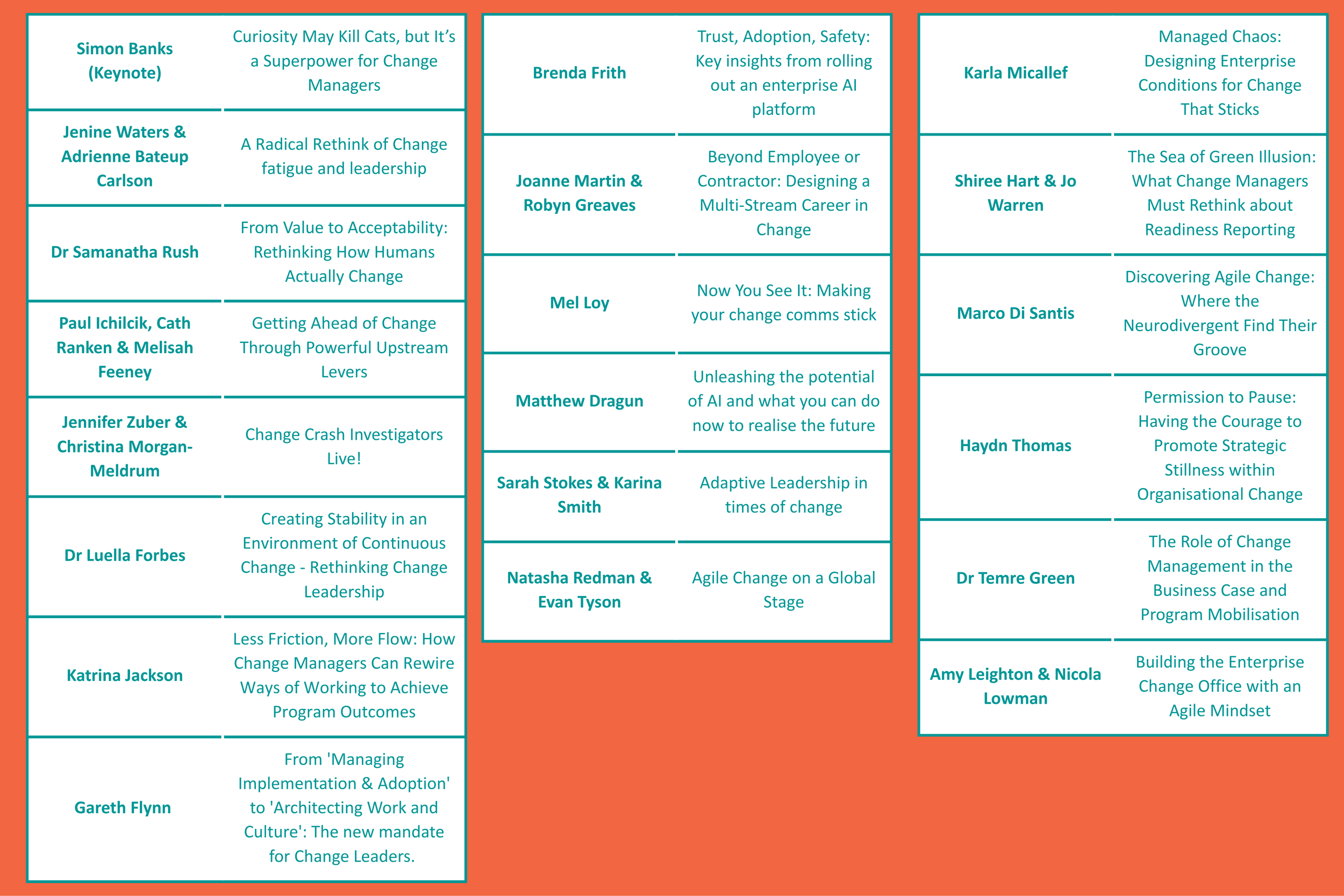
Simon Banks - Keynote (Livestream)
Curiosity May Kill Cats, but It’s a Superpower for Change Managers
Curiosity is like your superhero cape. The good news? It’s available to anyone, anytime. If we want to rethink change, we need tools that help us see with new eyes, not just sharpen the same lens.
So how do you amp up your curiosity? It starts with opening your eyes. When we do, we notice things others miss. And that’s exciting. This isn’t your usual keynote. You’ll build your curiosity by diving into some of the world’s most iconic artworks, uncovering hidden details, overlooked connections and the stories behind them.
You’ll train your eyes in the skill of seeing the unseen, noticing cultural blind spots, challenging assumptions and spotting what we usually speed past.
-
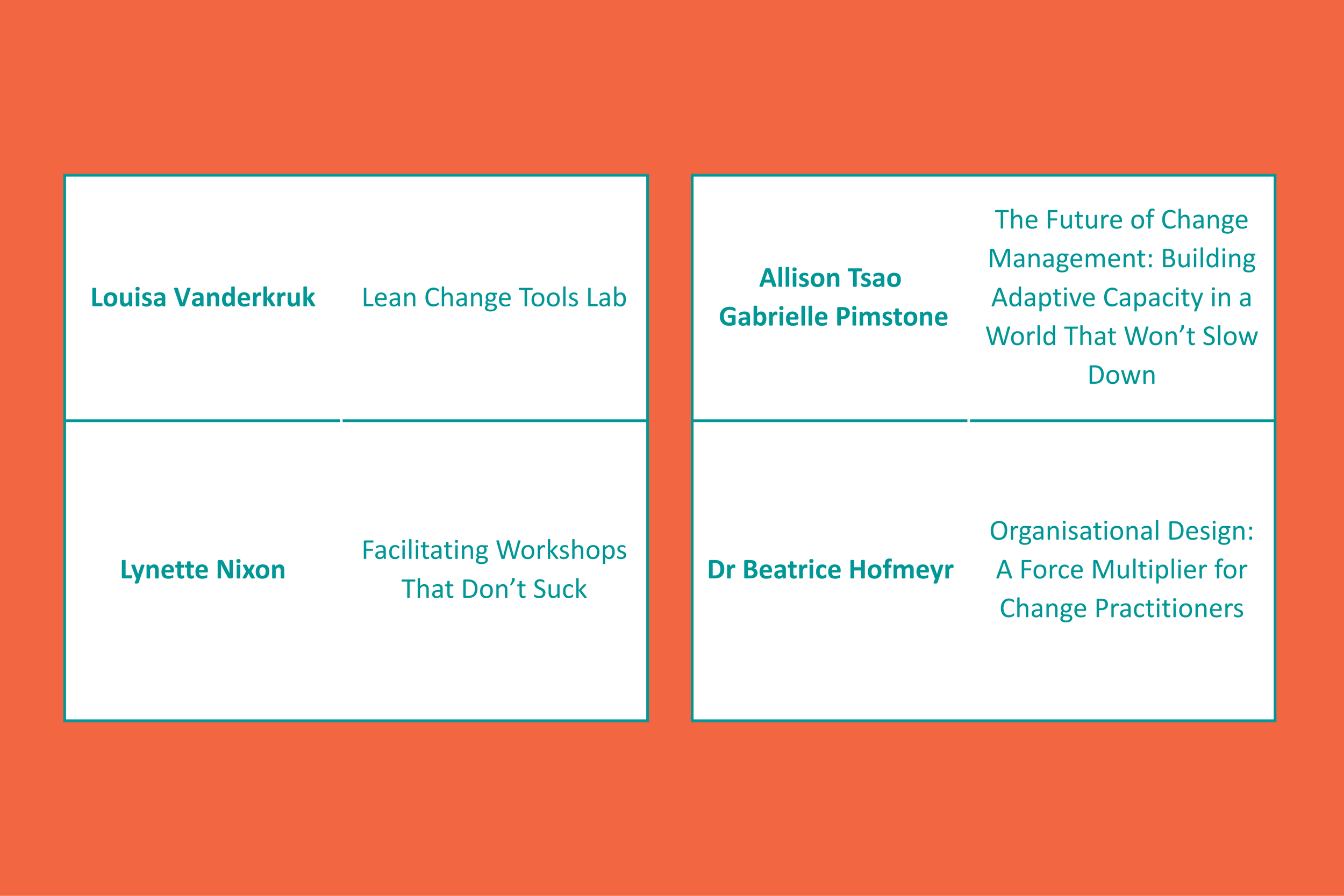
Louisa Vanderkruk (Masterclass)
Lean Change Tools Lab
This hands‑on workshop gives time‑pressed practitioners practical experience using a curated set of lean change tools to design an implementable change strategy.
Working on a real scenario with peers, participants will learn through doing while applying the core principles of lean change. This masterclass emphasises fast, collaborative planning and helps attendees evaluate each tool’s effectiveness and appropriate use.
Everyone leaves with adaptable templates, practical experience, and a clear understanding of how to apply these tools confidently in their own projects.
Learning objectives
By the end of this workshop you can expect to be able to:
1. Apply a curated set of lean change tools to a real project – gaining practical, hands-on experience you can take straight back to your work.
2. Evaluate the strengths and limitations of each tool – so you can choose the right tool for the right situation with confidence.
3. Tailor and adapt tool templates for your own context – ready to put them into practice from next week.
-
Lynette Nixon (Masterclass)
Facilitating Workshops That Don’t Suck
Most of us have sat through workshops that felt like hostage situations - too long, too vague, and full of post-its destined for the bin. Today is not one of those. We're breaking down what actually makes a 'workshop work', and we'll model every technique as we go. Expect practical tools, real talk, and a bit of playful chaos - no fluff, no theatre, just craft you can use tomorrow.
Learning objectives
By the end of this masterclass you can expect to be able to:
1. Design workshops with clear purpose, outcomes, and flow – so you can translate a brief into a structured, human-centred workshop design.
2. Facilitate with confidence and adaptability – able to apply core facilitation techniques and respond effectively to real-time group dynamics.
3. Diagnose and improve workshop effectiveness - able to identify common design and facilitation pitfalls and redesign workshops using a simple, repeatable framework.
4. Turn workshop outputs into actionable insights – apply the techniques required to translate group work into decisions, artefacts, and follow-through that drive real change.
-
Allison Tsao and Gabrielle Pimstone (Masterclass)
The Future of Change Management: Building Adaptive Capacity in a World That Won’t Slow Down
Change management was designed for a predictable, linear, and stable world - a world most organisations no longer inhabit. Today, the challenge isn’t just executing change; it’s whether leaders and systems can absorb disruption without fragmenting or burning out.
This masterclass unpacks the next horizon of change management. It is designed to help practitioners put on an adaptive lens to see resistance, fatigue, and stalled initiatives not as ‘failures’, but as signals of systemic overload.
In this hands-on session, participants will engage in a facilitated simulation (experiencing system dynamics in real time) and learn tools to rethink change: to “see” the system, uncover pressure points that inhibit change, and take action to build adaptive capacity across eight dimensions.
The session blends left and right brain learning, combining analytic insight with real-time, felt experience. They will practice systems thinking in an energising way and collaborate with other practitioners who feel that traditional approaches are no longer enough.
Learning Objectives:
1. Apply criteria to decide whether a traditional or transformational change approach is needed for project success
2. Map your change project against the 8 adaptive dimensions to identify obstacles and high-impact intervention points
3. Implement simple ‘adaptive change’ tools to address system blockages, engage stakeholders, and maintain project momentum
-
Dr Beatrice Hofmeyr (Masterclass)
Organisational Design: A Force Multiplier for Change Practitioners
Learn how organisational design elevates change practice, sharpens decision-making, and helps you deliver more durable transformation outcomes
As change practitioners, we often find ourselves managing resistance, confusion and fatigue that aren’t caused by the change itself - but by organisational structures that are no longer fit for purpose. We are often the first to sense when a transformation is being undermined by structural issues - unclear roles, decision bottlenecks, duplicated effort, misaligned capabilities. Most change practitioners have never been formally taught organisational design — yet a working knowledge of when and how to apply it has become critical to delivering successful change.
This masterclass is designed to demystify organisational design for change practitioners and show how it can be used to enhance your practice, increase your impact, and strengthen transformation outcomes.
-
Jenine Waters & Adrienne Bateup Carlson (Livestream)
A Radical Rethink of Change Fatigue and Leadership
The human elements of change: capacity, communication and the Slow Change Movement Change fatigue isn’t a people problem. It’s a leadership choice.
Organisations are asking their people to absorb more change than ever, and the truth is, most of it isn’t sticking. This session challenges the assumption that more change equals more progress, reframing transformation through the lens of human capacity, communication and culture.
A pragmatic, human‑centred approach that helps leaders choose the changes that matter, communicate them in ways people can absorb, and create the conditions for sustainable progress.
-
Dr Samanatha Rush (Livestream)
From Value to Acceptability: Rethinking How Humans Actually Change
Change efforts often fail not because people don’t see the value, but because the change is not acceptable to them in context. Acceptability is shaped by decision conditions, perceived risk, psychological safety, and individual differences. When we design change without attending to these factors, resistance is a predictable outcome. This session presents my doctoral research on the topic of perceived acceptability and how it is the missing link to successful change.
-
Paul Ichilcik, Cath Ranken & Melisah Feeney (Livestream)
Getting Ahead of Change Through Powerful Upstream Levers
This panel explores why organisational change succeeds or fails long before execution begins, and how changemakers can dramatically improve outcomes by paying attention to the upstream conditions that shape alignment, behaviour, and trust. Before rushing to apply tools or frameworks, it is critical to understand why transformations often derail at the human level and how to set up the conditions for sustained organisational change.
The three levers to be explored include 1) The quality of conversations at the executive table 2) The psychosocial impact of change on people and teams 3) Change communications that consistently inspire action.
Together, these levers provide a practical, integrated approach to change leadership that connects executive sense making, human experience, and people-focused communication.
-
Jennifer Zuber & Christina Morgan-Meldrum (Livestream)
Change Crash Investigators Live!
Christina and Jennifer will work through a live “change crash” using their unique blend of inquisitive questioning, storytelling and 60+ years of combined change management experience.
Join them as they deep-dive into a change initiative that has gone wrong (or is about to go wrong) with time for audience participation and questions.
They’ll talk about how to right the course and ensure your change doesn't become the next change crash, being sure to protect identities of individuals and companies.
This is definitely a super-fun way to learn - no slides, just really good conversation!
-
Dr Luella Forbes (Livestream)
Creating Stability in an Environment of Continuous Change - Rethinking Change Leadership
In today’s environment, organisations face multiple change events at once — digital, workforce, strategic and sustainability. This session explores how leaders and change practitioners can rethink traditional approaches such as Kotter and ADKAR to stay effective when everything is moving. Luella will share practical guidance on what to prioritise, how to create clarity from complexity, and why middle managers are essential anchors in continuous change. Ideal for anyone responsible for leading or enabling change.
-
Katrina Jackson (Livestream)
Less Friction, More Flow: How Change Managers Can Rewire Ways of Working to Achieve Program Outcomes
Less friction, more flow: How Change Managers can re-wire ways of working to achieve program outcomes Change managers are carrying more than ever: they’re the catch‑all role, in every meeting, trying to move stakeholders who have zero time or capacity. This talk is about shifting from simply absorbing more work to redesigning how you, and your collaborators, actually work together.
We’ll explore practical habits and plays that help you protect your own capacity and influence the hidden behaviours and ways of working that make or break a transformation. You’ll walk away with a concrete playbook to save yourself from burnout while driving better outcomes with sponsors, leaders, and teams.
-
Gareth Flynn (Livestream)
From 'Managing Implementation & Adoption' to 'Architecting Work and Culture': The new mandate for Change Leaders.
For the last 20 years, change management has largely focused on helping companies implement initiatives and people adopt them. In the age of AI, that playbook is obsolete. We are no longer just upgrading tools and processes; we are fundamentally restructuring work and the workforce.
The narrative that 'AI will take our jobs' is unhelpful. The reality is more nuanced: AI will take 'tasks', and it will demand new skills. This shift requires a new kind of leadership, one that can navigate the messy, complex grey zone between human capability and machine intelligence.
Gareth will challenge the audience to step up. He will demonstrate why change and transformation leaders are ideally placed to solve the biggest problem in business today: designing an operating model where AI handles the drudgery, and humans are unleashed to solve novel problems.
This session is your call to action. Learn why your role is becoming more mission-critical, not less. You will leave with a practical roadmap for evolving from a 'gatekeeper of change' to an 'Architect of work and workforce' who will drive business survival in the AI era.
-
Brenda Frith
Trust, Adoption, Safety: Key Insights from Rolling Out an Enterprise AI Platform
Trust, Adoption, Safety: Key insights from rolling out an enterprise AI platform A practical case study on rolling out an Enterprise AI platform to over 500 employees in multiple locations across Australia.
The session will focus on the story of the rollout, key insights and tips for introducing AI in a responsible way that builds trust, adoption and psychological safety.
-
Joanne Martin & Robyn Greaves
Beyond Employee or Contractor: Designing a Multi-Stream Career in Change
Beyond Employee or Contractor: Designing a Multi-Stream Career in Change Change practitioners help organisations navigate disruption — yet many still structure their own careers around traditional employee or contractor models.
In this highly interactive session, participants will explore how to design resilient, multi-stream careers through fractional roles, advisory work, interim assignments, and project-based engagements. Through practical exercises and live demonstrations, including the application of AI-enabled tools, attendees will strengthen their communication capability, professional visibility, and strategic influence.
Participants will leave with practical techniques and immediately applicable ideas to expand their change toolkit and increase their impact.
-
Mel Loy
Now You See It: Making Your Change Comms Stick
Change isn't just bigger and faster than ever before ... in many cases, it's also more complex. And when you're dealing with audiences who are teetering on the edge of change apathy, you need more than just a whiff of hope to get people to not just understand, but be motivated by change.
In this session, you'll learn how to create a compelling case for 'why' that cuts through the noise, and then how to use visuals and tech tools to make your change easier to manage and understand.
You'll be inspired by new ideas, have new skills to experiment with, and have some fun along the way!
-
Matthew Dragun
Unleashing the potential of AI and what you can do now to realise the future
Are you seeking to understand how to truly unlock the potential of AI within your change practice—and what it will take to stay ahead as the landscape rapidly evolves?
This session explores the emerging future of AI-enabled change management, offering a forward-looking vision of how the discipline is set to transform. It will examine what leading AI-powered change teams will look like, how the human–AI interface is likely to redefine where change professionals create value, and how agentic workflows could fundamentally expand capacity and reshape ways of working.
The session will also highlight the growing importance of data and organisational knowledge, alongside the evolution of tooling as a critical connective layer across the change ecosystem.
Designed for senior change leaders, this session focuses on the opportunity ahead—what is coming, what it means for our profession, and the steps leaders can take now to position their teams to fully realise AI’s potential.
Attendees will leave with a clearer perspective on how to set their change practice up for the future, challenge conventional thinking, and lead with confidence in an AI-enabled world.
-
Sarah Stokes & Karina Smith
Adaptive Leadership in Times of Change
This workshop supports change leaders to lead effectively when certainty is unavailable, a challenge that is particularly acute with the adoption of AI, where the landscape of opportunities and risks evolves weekly.
Because we can’t rely on an existing playbook, we must move away from the idea of executing a linear transition and focus instead on the human-centered navigation of a system in constant motion. To do this, leaders need to learn how to sense, test, and learn in real time, rather than over-investing in upfront plans.
Drawing on design thinking and adaptive leadership, we will explore how to lead change when the future isn’t certain.
-
Natasha Redman & Evan Tyson
Agile Change on a Global Stage
Agile change sounds great in theory, but what truly happens when you apply it inside a large, complex, global ERP program? What does it look like when a change leader steps into a program already running Agile (or “wagile”)?
How do you adapt traditional change practices to Agile ways of working, make change work visible in sprints, and break activities into pieces that fit an iterative delivery model? And importantly, how can Agile ways of working strengthen the impact of change?
This session goes beyond theory. You’ll hear what worked, what didn’t, what we adapted along the way, and how Agile change became a practical, scalable way of delivering readiness at pace. Packed with relatable scenarios and actionable techniques, attendees will walk away with tools and insights they can apply immediately.
-
Karla Micallef
Managed Chaos: Designing Enterprise Conditions for Change That Sticks
Organisations are facing unprecedented volumes and velocity of change without a shared enterprise view of priorities, timing or clear accountability. The result is unmanaged chaos, where good initiatives compete, collide and erode value.
Managed Chaos introduces a practical model for designing the enterprise conditions, from prioritisation and governance through to sequencing and capability, that enable speed, discipline and stronger execution.
Whether you are a change executive shaping strategy or a practitioner working within it, you will gain practical ways to influence and build enterprise change maturity from the top down or the bottom up.
-
Haydn Thomas
Permission to Pause: Having the Courage to Promote Strategic Stillness within Organisational Change
What if the most courageous thing a change leader could do is... stop changing?
This thought-provoking presentation challenges the assumption that organisations must be in constant transformation to remain competitive.
Haydn makes the case for "strategic stillness" - intentional periods where organisations consolidate, master, and extract value from recent changes before launching the next initiative.
Learn to: 1. Recognise when your organisation needs integration rather than innovation 2. How to build the business case for hitting pause 3. Discover strategies to recognise and push back on unnecessary change.
-
Marco Di Santis
Discovering Agile Change: Where the Neurodivergent Find Their Groove
Imagine if Agile wasn’t just about delivering projects - but about creating belonging.
For many, Agile change unlocks possibilities. For neurodivergent professionals, it can be the key to thriving. In this candid and thought-provoking session, Marco Di Santis shares his personal journey as a neurodivergent change professional — how Agile helped him make sense of his working style, tap into his strengths, and show up more authentically.
-
Shiree Hart & Jo Warren
The Sea of Green Illusion: What Change Managers Must Rethink about Readiness Reporting
Organisational leaders often think of “change readiness” as a box to tick, an early project milestone that signals people are informed, aligned, and prepared.
In reality, readiness is rarely a moment in time. It is a dynamic capability that must be cultivated, tested, and strengthened throughout the entire change journey. Yet across programmes of every size, leaders consistently underestimate what true readiness requires.
Drawing on insights from leading transformation initiatives across Aotearoa, this session explores the most common misconceptions leaders hold about change readiness, why they occur, how they impact delivery, and what change practitioners can do to address them early.
Participants will gain a practical, real-world framework for diagnosing readiness at multiple levels, identifying the cultural and operational signals that matter most, and shifting leadership conversations.
This session is designed for leaders, change professionals, and programme teams seeking a more honest, data-informed, and human-centred approach to readiness, one that aligns people, knowledge, and delivery from the outset.
-
Dr Temre Green
The Role of Change Management in the Business Case and Program Mobilisation
We talk a lot about adoption in Change Management, but where does “getting adoption” actually start?
In this presentation, Temre will dive deep into the Change Practitioner’s role prior to program commencement. She will provide a real example of effective pre-program planning during the business case and program mobilisation phase to improve the likelihood of achieving program outcomes.
-
Amy Leighton & Nicola Lowman
Building the Enterprise Change Office with an Agile Mindset
Building the Enterprise Change Office with an Agile Mindset This session shares Aurecon’s practical journey in establishing an Enterprise Change Office—why it was needed, how it was built and the organisational shifts it enabled.
We explore how an agile mindset transformed our approach to change, using iterative design, faster alignment and a more human‑centred “change experience” focused on moments that matter.
Participants will gain practical insights into our Minimum Viable Change Process (MVCP) and walk away with proven, adaptable approaches they can apply immediately in their own change environments.